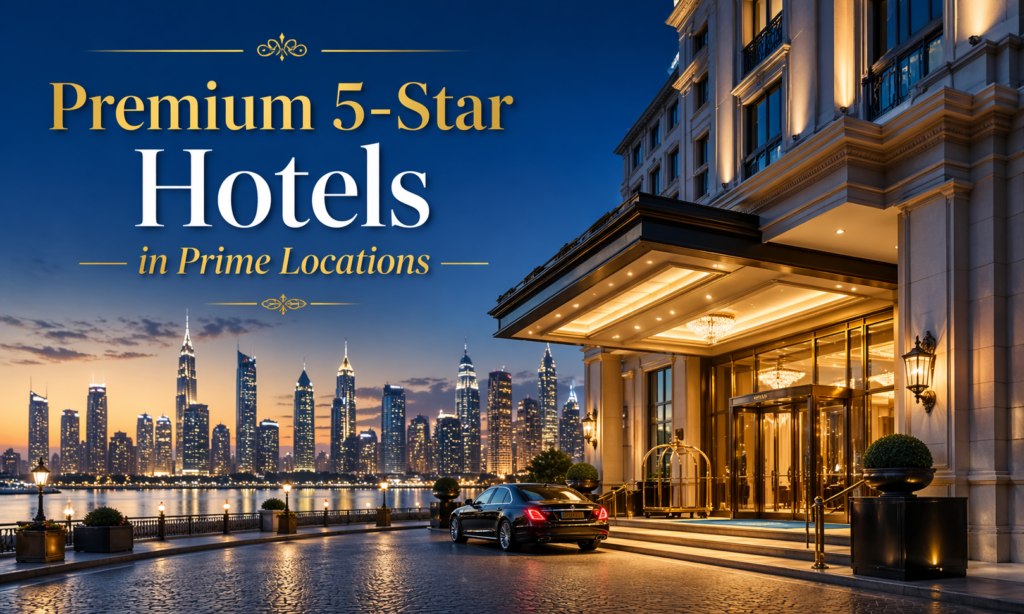
Why Prime Location Still Defines True Luxury
(Premium 5-Star Hotels) A premium 5-star hotel can have marble bathrooms, flawless sheets, and a lobby that smells like expensive citrus, but none of that fully lands if the location misses the mark. In luxury hospitality, the address is not just a detail tucked into a booking page. It is part of the product itself. A hotel in a prime location saves time, improves convenience, unlocks better views, and places the guest closer to the reason they traveled in the first place. That reason may be finance meetings in central London, shopping in Paris, dining in Tokyo, or a restorative beachfront escape in Bali. The point is simple: true luxury feels effortless, and a great location removes friction before the guest even reaches the front desk.
That idea is backed by what is happening in the hotel market right now. CBRE’s 2025 Global Hotel Outlook says urban locations are expected to post the strongest RevPAR growth at 2.8%, while higher-priced hotels are expected to outperform as international travel, group demand, and business travel improve. In Asia-Pacific, CBRE notes that international arrivals were up 31% in 2024 and were expected to fully recover in 2025, with upscale and luxury segments positioned for growth as wealth expands across the region. That matters because prime locations are most often urban gateways, luxury resort corridors, and high-demand mixed-use districts. In other words, the best-performing premium hotel markets are not random dots on a map. They are magnets for business, tourism, prestige, and lifestyle value.
What Makes a 5-Star Hotel Feel Truly Premium
A 5-star hotel becomes premium when it delivers something richer than standardized luxury. Plenty of hotels can offer polished check-in desks and attractive rooms. Premium properties go further by creating a sense of precision. Staff remember names, preferences, dietary restrictions, and travel purpose. Rooms feel designed rather than decorated. Dining is not just available; it is memorable. Spa programs are not generic; they are identity-defining. The guest does not feel processed. The guest feels understood. That is the difference between staying somewhere expensive and staying somewhere exceptional.
(Premium 5-Star Hotels) Independent luxury rating systems reinforce this distinction. Forbes Travel Guide describes itself as the world’s only independent global rating system for luxury hotels, restaurants, spas, and ocean cruises. Its 2025 Star Award Winners span 90 countries, marking the most geographically diverse list in the organization’s history. That tells us something important. Luxury has widened geographically, but premium quality still depends on standards that go beyond glossy photography. Service consistency, physical excellence, emotional intelligence, privacy, and the ability to deliver seamless experiences remain the real differentiators.
Guests also want more from the property itself than a room and a pool. Premium hotels now compete through wellness, culinary identity, and high-touch personalization. A city hotel may win through concierge depth, private transfer execution, and proximity to flagship business districts. A resort may win through beach access, spa rituals, private villas, and a stronger sense of place. The common thread is that the hotel feels like a carefully tuned instrument. Every part of the stay supports the guest’s goals, whether those goals are efficiency, indulgence, recovery, romance, or status.
The World’s Strongest Prime Hotel Markets
(Premium 5-Star Hotels) When people search for premium 5-star hotels in prime locations, they are usually talking about one of two categories. The first is the elite urban market: gateway cities with deep corporate demand, strong international arrivals, famous shopping districts, and recognizable luxury neighborhoods. The second is the destination resort market: places where the natural setting becomes part of the luxury equation. Both categories are thriving, but they satisfy different travel instincts.
In Europe, London and Paris remain obvious powerhouses. CBRE’s European Hotels Destination Index says London leads Europe with unmatched scale, liquidity, and global demand, while Paris follows with strong demand fundamentals and exceptional RevPAR performance. The same report places Barcelona, Madrid, and Rome in a strong tier supported by robust tourism flows, while international gateways dominate hotel market size. A luxury traveler booking in Mayfair, Knightsbridge, the 8th arrondissement, or a landmark district near the Seine is not simply paying for prestige. They are paying for access, atmosphere, and reduced travel friction across an entire itinerary.
In Asia and the Middle East, prime hotel demand remains powerful in cities like Dubai, Singapore, and Tokyo, while resort destinations such as Bali continue to draw premium travelers who want location-led experience. Forbes Travel Guide maintains destination listings for luxury hotels in Jakarta and Bali, showing how these markets remain firmly on the luxury map. Hilton’s 2025 luxury trends material also points to expansion in coveted locations such as London, Costa Rica, Hanoi, Kuala Lumpur, Jakarta, and Sydney, reflecting how global brands are placing their premium flags where wealthy travelers already want to go. When brands race toward a location, that usually signals one thing: sustained demand.
Here is a simple view of how prime hotel markets differ:
| Location Type | What Guests Value Most | Best For | Luxury Advantage |
|---|---|---|---|
| Global gateway cities | Access to finance, culture, shopping, landmarks | Business trips, short luxury stays, mixed itineraries | Saves time and adds prestige |
| Urban lifestyle capitals | Dining scenes, design districts, entertainment | Couples, trend-driven travelers, premium city breaks | Immersive, energetic, social |
| Beach and island resorts | Views, privacy, wellness, seclusion | Honeymoons, family escapes, restorative travel | Scenery becomes part of the stay |
| Mixed business-leisure hubs | Strong connectivity plus leisure options | Bleisure travelers, executive families | Flexible and efficient |
Why Demand for Premium Hotels Remains Strong
Luxury hotels are not surviving on image alone. The numbers support the story. CBRE expects higher-priced hotels to outperform in 2025, helped by mid-single-digit growth in inbound international travel and modest recovery in group and business demand. Skift also reported that in the U.S., luxury and upper-upscale hotels were expected to lead RevPAR growth in 2025, outperforming lower-tier segments. This is a crucial point for anyone writing about or investing attention in premium 5-star hotels. Consumers are still spending for value they can feel. They may be more selective than before, but they continue to reward properties that combine status, convenience, and experience.
(Premium 5-Star Hotels) Why is that happening? Part of the answer is that travel has become more intentional. People are no longer choosing hotels only by room rate or brand familiarity. They want fewer compromises. If a traveler is crossing continents for a milestone trip, a major event, or a blended work-and-leisure schedule, they are more likely to pay for the right address and the right operational standard. Hilton’s 2025 trends report captured that mindset clearly. CEO Chris Nassetta said travelers want to “maximize every moment of their time away.” That one line explains a lot about premium hotel demand. A prime location does exactly that. It cuts waste, reduces transit time, and raises the quality of every hour on the itinerary.
The same logic also explains the appeal of bleisure travel, where work and personal time overlap. A premium hotel in a central district lets a guest finish meetings, walk to dinner, access shopping or entertainment, and still return to a quiet, controlled environment. That is not just convenience. It is a form of luxury efficiency. In resort markets, the equation flips but the principle stays the same. Travelers want settings where the destination itself does the heavy lifting, whether that means direct beach access, panoramic mountain views, or built-in wellness routines.
How to Choose the Right Premium 5-Star Hotel
Choosing the right premium 5-star hotel is a bit like choosing a tailored suit. The label matters, the material matters, but the fit matters most. The best hotel for one traveler may be the wrong hotel for another, even if both properties are objectively excellent. That is why the smartest travelers begin with purpose, not just star level. Are you traveling for business, romance, rest, shopping, dining, or a family celebration? Each goal points toward a different kind of prime location.
For business-focused travel, a premium urban hotel works best when it is close to meeting venues, financial districts, embassies, and strong transport links. That leisure-heavy city travel, a prime location usually means proximity to signature neighborhoods, museums, luxury retail, and celebrated restaurants. For a beach or island stay, the most premium address is not always the busiest one. Sometimes the better choice is a hotel with controlled privacy, cleaner access to natural scenery, and enough distance from crowded tourist corridors to make the stay feel protected. Luxury is not always about being in the center of noise. Sometimes it is about being perfectly placed just outside it.
Ratings also matter, but smart readers look at independent ratings instead of relying only on marketing claims. Forbes Travel Guide’s star system is useful because it evaluates actual hospitality performance rather than just brand storytelling. A premium traveler should also read recent guest feedback with a filter: look for comments about service recovery, noise control, housekeeping consistency, breakfast quality, concierge strength, and overall flow of the stay. Anyone can be impressed by a chandelier in a lobby photo. The better question is this: does the hotel continue to feel premium on day two, not just in the first ten minutes?
Another common mistake is obsessing over room size while ignoring the broader property ecosystem. A slightly smaller room in the right neighborhood with better service, dining, spa quality, and smoother transportation may easily outperform a larger room in a weaker location. Prime-location luxury is not one ingredient. It is a stack of advantages that compound throughout the stay.
Prime Location vs. Prime Experience
There is a useful tension in luxury hospitality between prime location and prime experience. The best hotels manage to deliver both, but travelers often lean emotionally toward one side. Some want to be in the middle of everything. Others want to feel they have escaped everything. Neither preference is wrong. The real question is whether the property’s location strengthens the kind of experience being sold.
A city-center hotel offers instant practical value. You step out and the destination begins. The best addresses in London, Paris, Singapore, Tokyo, or Dubai function almost like a master key. They unlock restaurants, boardrooms, flagship shopping, nightlife, and iconic streets with minimal effort. This is why gateway cities and CBD locations remain preferred investment targets. CBRE’s investor survey found that 65% of respondents identified CBD and gateway cities as top choices, up from 57% in 2024. Investors follow demand, and demand follows usefulness. In prime urban luxury, usefulness is beautiful.
A resort hotel works differently. Here, the destination may be the property itself. Ocean views, private pools, wellness pavilions, and curated local experiences become part of the emotional architecture of the trip. The location still matters, but in a more atmospheric way. Guests pay for distance from stress, not closeness to meetings. They pay for sunrise over the water, uninterrupted quiet, and the sense that time has softened around them. This is why places like Bali continue to hold such strong luxury appeal. The setting completes the promise of the hotel rather than merely supporting it.
The smartest luxury travelers know how to read this difference before they book. They do not just ask whether the hotel is expensive, famous, or photogenic. They ask whether the location amplifies the reason for the trip. That one mindset shift can turn a good stay into the right stay.
The Role of Brand Reputation and Independent Ratings
Brand strength matters in the 5-star hotel world because it lowers uncertainty. When a traveler books a well-known luxury flag, they expect a certain level of bedding quality, food standards, staff training, design language, and reservation support. That consistency is valuable, especially for international travelers juggling long-haul flights, events, or multi-city itineraries. Yet brand reputation alone does not guarantee excellence. Some hotels trade on reputation the way old theaters trade on their façades: the outside remains impressive even if the backstage systems need work.
That is where independent validation becomes useful. Forbes Travel Guide’s 2025 awards matter not because they create luxury, but because they help separate polished marketing from proven execution. The fact that the 2025 winners span 90 countries also shows that premium hospitality is no longer concentrated in a narrow group of legacy capitals. The luxury map is broadening, but standards still matter. A traveler choosing among several top properties in a prime destination can use these independent recognitions as a practical signal.
Brand expansion is another clue worth watching. Hilton said its luxury portfolio surpassed 500 properties worldwide in 2024, and its luxury brands are expanding into several highly coveted locations. Expansion by global operators usually reflects more than optimism. It reflects data, demand forecasts, loyalty economics, and confidence in the long-term pull of a destination. If a major luxury brand is adding inventory to London, Jakarta, Sydney, or Costa Rica, it is because these places are attracting travelers who still value premium accommodation enough to pay for it.
Trends Shaping Premium 5-Star Hotels in 2026
The future of premium hotels in prime locations will be shaped less by superficial opulence and more by meaningful experience. Travelers still love beautiful design and visible status markers, of course. But the next layer of luxury is not louder. It is smarter. Guests want the stay to feel frictionless, relevant, and emotionally satisfying. That means better pre-arrival communication, more intuitive room technology, more thoughtful wellness programming, and stronger local identity instead of generic luxury templates.
Experience-led travel is already pushing the sector in that direction. American Express Travel’s 2025 Global Travel Trends Report highlighted the way people are drawing inspiration from entertainment, personal passions, and meaningful experiences when planning trips. Hilton’s trends reporting also reflects a world where work, relaxation, and connection blur together. In premium hospitality, that means the hotel must perform across multiple use cases at once. A guest may need a productive work table at 9 a.m., an excellent spa at 4 p.m., and a memorable chef-led dinner at 8 p.m. The property has to handle that complexity gracefully.
Responsible luxury is also moving from a side note to an expectation. Forbes Travel Guide’s Responsible Hospitality program highlights properties meeting more than 100 stringent standards connected to environmental and community well-being. Affluent guests increasingly want premium travel that feels aligned with modern values, not disconnected from them. The winning formula is no longer excess for its own sake. It is intelligent indulgence: high standards, lower friction, stronger purpose, and a location that turns the whole trip into something smoother, richer, and more memorable.
Conclusion (Premium 5-Star Hotels)
The phrase premium 5-star hotels in prime locations works because each word adds something essential. Premium means the experience is elevated, not just expensive. 5-star signals a high service benchmark. Prime locations ensure the hotel is not fighting against the trip, but actively improving it. That combination is why luxury travelers continue to favor city-center icons, elite resort enclaves, and globally recognized gateway destinations.