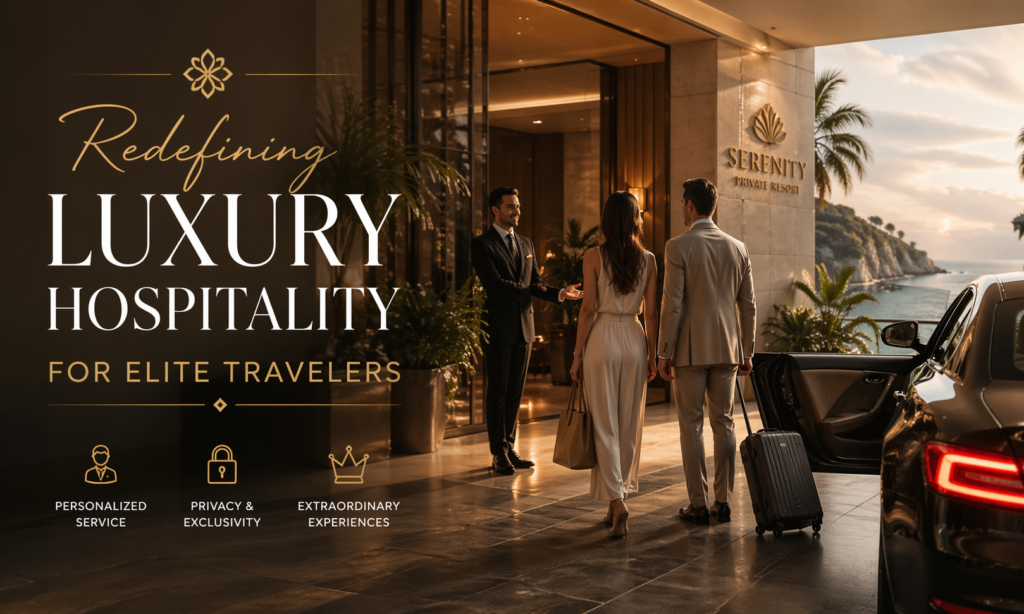
Introduction: Why Luxury Hospitality Is Being Rewritten
(Redefining Luxury Hospitality) Luxury hospitality is no longer winning simply because a lobby shines brighter, a suite sits higher, or a chandelier costs more than a family home. The definition has shifted, and the shift is not subtle. Current industry reporting shows that luxury travel demand remains strong, affluent travelers are still spending, and operators are rethinking how to deliver exclusivity in a world where premium design, digital convenience, and polished service have become easier to imitate across categories.
McKinsey notes that a large share of the luxury-travel market is not made up only of ultra-wealthy guests, while Deloitte points to resilient travel demand and rising AI use cases across customer experience and operations. At the same time, Virtuoso’s 2025 findings show that affluent travelers are prioritizing family travel, celebration travel, authenticity, and cultural immersion, which means elite hospitality is becoming more emotional, more intentional, and more experience-led than many legacy brands were built for.
That is why luxury hospitality is being redefined from the inside out. It is less about visible abundance and more about curated ease. It is less about proving wealth and more about protecting time. The elite traveler still expects beautiful rooms, flawless bedding, and high-end dining, of course, but those are now entry tickets rather than differentiators.
What stands out today is how intelligently a hotel reads a guest, how smoothly it removes friction, how private it feels, and how deeply it connects the traveler to the place without making that connection feel manufactured. In other words, the best luxury hospitality strategy now works like a great tailor: invisible in the moment, unforgettable in the result.
What Luxury Means Now (Redefining Luxury Hospitality)
The old version of luxury hospitality was built on visible cues. Think marble, crystal, dramatic foyers, white-glove rituals, and a kind of theatrical elegance that told guests they had arrived somewhere important. That language still matters, but it no longer carries the same power on its own. McKinsey’s interview with Virtuoso founder Matthew Upchurch captures the modern shift perfectly: luxury is ultimately about how the customer feels, not just what the customer sees.
That insight matters because it changes everything from hotel design and staffing to CRM systems and guest journey mapping. A property can have every premium amenity in the book and still fail the modern elite traveler if it feels generic, rigid, or impersonal.
For elite travelers, the new luxury standard blends emotional intelligence with operational excellence. The traveler wants effortless arrivals, intuitive recognition, meaningful privacy, and a sense that each detail has been assembled around personal preference rather than brand standardization.
This is why leading luxury brands are putting more energy into villas, curated excursions, wellness programming, private transport coordination, and ultra-responsive pre-arrival planning. Skift’s 2025 reporting on luxury hospitality highlights the category’s competitive pressure and the need for brands to differentiate with sharper guest understanding, especially as new wealth growth in Asia opens fresh opportunity. In simple terms, luxury has moved from “look how much we offer” to “look how precisely we understand you.”
Feeling Matters More Than Flash (Redefining Luxury Hospitality)
One of the clearest signals in modern luxury travel trends is that emotional outcome has become a core product. Guests are not just buying a room; they are buying a state of mind. They want calm, reassurance, delight, recovery, family closeness, or cultural enrichment. Upchurch’s point that the real differentiator is how the customer feels sounds simple, but it is actually strategic gold. When a hotel shifts its planning around emotion, the service model becomes less transactional and more anticipatory. Suddenly, minibar preferences, pillow type, airport pacing, quiet dining corners, scent sensitivity, childcare logistics, and post-flight recovery matter just as much as thread count.
This emotional approach also explains the rise of what many operators call “quiet luxury” or “deep luxury.” Guests with serious money increasingly do not need hospitality to shout. They need it to understand. The highest form of service today is not a performance. It is precision without noise. A guest who never has to repeat dietary needs, never waits awkwardly at check-in, never feels oversold, and never has to hunt down support is experiencing a rarer kind of luxury than a guest who merely sees gold accents and branded gifts. That is a crucial SEO truth for hospitality brands too: luxury hotel experience now ranks in the mind of the consumer above pure luxury hotel image.
Personalization at Scale (Redefining Luxury Hospitality)
Here is the challenge: guests want bespoke treatment, but many luxury groups are getting larger, not smaller. McKinsey notes that 70 percent of luxury-hotel properties are independent, yet the supply pipeline is increasingly dominated by chains and franchises, which means the biggest brands face a balancing act between scale and exclusivity. That tension is shaping the next generation of luxury hospitality management. The winners will be the companies that can industrialize insight without industrializing the guest experience.
That requires strong data discipline, not gimmicks. Guest preference profiles, cross-property recognition, flexible service scripting, and empowered staff are becoming the backbone of premium personalization. The best systems are not loud. They are useful. A returning guest should feel known, not monitored. A repeat family should notice that the room setup already fits their rhythm. A business traveler extending into leisure should see a stay shift from productive to restorative without extra effort. Personalization at scale is a little like conducting an orchestra: technology keeps the tempo, but human judgment makes the music. Deloitte’s 2025 outlook also reinforces this direction by showing how AI is being applied to personalized hotel guest communications and broader experience optimization.
The Return of the Trusted Advisor (Redefining Luxury Hospitality)
People predicted travel advisors would fade into irrelevance. Luxury travelers disagreed. McKinsey points out that luxury travelers still rely on advisors because they want someone else to manage complexity and because top advisors now combine personal understanding with technology and global networks. Virtuoso’s 2025 Luxe Report strengthens that point: more than 2,200 advisors from 58 countries contributed insight, and half expected travel demand to rise slightly while 20 percent expected a significant increase. For luxury hospitality brands, this matters because elite travel is still relationship-driven.
Hotels that treat advisors as strategic partners rather than just distribution channels gain access to a powerful trust layer. Elite travelers often do not choose a property by searching “best 5-star hotel” and clicking the first result. They choose through recommendation, fit, context, and service confidence. That means the modern luxury hotel brand must market to two audiences at once: the guest and the gatekeeper. It must be desirable enough to inspire direct interest, but reliable enough to win advisor advocacy. In luxury, recommendation is not just traffic. It is transferred trust.
Experience Has Become the New Status Symbol (Redefining Luxury Hospitality)
One of the most important current luxury travel insights is that affluent travelers increasingly want stories, not just settings. Virtuoso’s 2025 report lists family travel, celebration travel, multigenerational family travel, adventure cruising, active travel, authenticity, beach resort stays, and cultural immersion among the biggest trends shaping affluent demand. That lineup tells a revealing story. Travelers are not chasing luxury only as comfort. They are chasing it as memory architecture. They want hospitality to turn time into something vivid, personal, and difficult to replicate.
This is where many old-school luxury properties either level up or get left behind. A hotel cannot be merely beautiful anymore. It has to be useful as a platform for exceptional living. That might mean creating meaningful family rituals, arranging impossible access, pairing guests with local experts, or designing wellness journeys that actually change how people feel. The room is still the stage, but the experience is now the plot. This is not a niche shift either. American Express Travel’s 2025 reporting shows travelers are prioritizing family-centric destinations, local recommendations, local small businesses, and smarter value extraction through points and perks. Even among premium consumers, luxury is becoming more intentional and less ornamental.
Family, Celebration, and Multi-Generational Travel
Family travel is no longer the soft side of luxury. It is one of its strongest engines. Virtuoso ranks immediate family travel first, celebration travel second, and multigenerational family travel third among major 2025 luxury travel trends. American Express also found that 81 percent of global respondents prefer destinations that are family-centric and offer activities for all ages, while 58 percent of Millennial and Gen Z parents surveyed planned to bring extended family on vacation in 2025. Those numbers matter because they show that today’s luxury hospitality market is increasingly organized around shared milestones, not just solo indulgence.
For hotels, this changes product design. Elite family travel demands privacy, flexibility, safety, and range. Parents want ease. Grandparents want comfort. Children want engagement. Everyone wants togetherness without feeling crowded. That is why connecting rooms are not enough anymore. The modern answer is villas, residences, buyouts, tailored family itineraries, intergenerational dining formats, kid and teen programming with genuine quality, and concierge teams who can pivot between celebration planning and practical troubleshooting in seconds. Great family-focused luxury hospitality feels like a private home that somehow also has an army of invisible experts behind the wall.
Authenticity and Cultural Immersion (Redefining Luxury Hospitality)
Affluent travelers still love comfort, but comfort alone is bland. Virtuoso identifies authenticity and cultural immersion among the top motivations shaping luxury travel, while American Express reports that 73 percent of global respondents say supporting local small businesses is important when visiting a new destination, and 67 percent typically use local recommendations, guides, or social media to find them. That combination shows a powerful shift: elite guests want to spend well, but they also want to spend meaningfully.
This creates a major opportunity for luxury hotels that behave less like sealed compounds and more like trusted cultural editors. The best properties no longer isolate guests from place; they translate place elegantly. They offer chef-led market visits, artist studio access, local textile workshops, guided heritage encounters, and region-specific wellness traditions without making the itinerary feel like a checklist. Done badly, authenticity becomes theater. Done well, it feels intimate and surprising. That distinction matters because the elite traveler is often very experienced. They can spot staged “local flavor” from a mile away. Hospitality brands that build deep local partnerships rather than decorative local narratives will keep winning this audience.
Wellness as a Core Luxury Product (Redefining Luxury Hospitality)
(Redefining Luxury Hospitality) Wellness has moved from spa menu add-on to central pillar of the modern luxury travel experience. McKinsey notes that luxury travelers increasingly want health, both mental and physical, at the center of their trips, and they are interested in destination-specific wellness practices rather than a token massage squeezed into a packed itinerary. Recent reporting also shows the wellness category stretching into more science-backed, preventive, and longevity-focused formats for affluent guests. The message is clear: elite travelers increasingly want to return home feeling better than when they left, not merely entertained.
For luxury hospitality, that means rethinking what wellness actually includes. It now spans sleep programs, circadian lighting, air and acoustic quality, healthy but desirable dining, recovery routines, guided movement, digital detox design, longevity diagnostics, thermal experiences, and emotional decompression. The best wellness hospitality does not force virtue on the guest. It makes wellbeing irresistible. That is a subtle but powerful difference. A truly modern luxury resort understands that relaxation is good, but restoration is better. And in a high-pressure world, restoration may be the most premium product of all.
The Technology Powering Seamless Luxury
(Redefining Luxury Hospitality) Technology in luxury hospitality works best when guests barely notice it. Elite travelers do not want to feel managed by software. They want technology to remove hassle, improve speed, and support personalization without flattening the human touch. Deloitte’s 2025 outlook highlights AI across customer service, operations optimization, shopping, discovery, and personalized communications, while American Express shows that travelers are actively using travel-friendly tech and loyalty ecosystems to smooth the planning and booking process. This means digital fluency is no longer optional for premium brands. It is core infrastructure.
The trick is avoiding sterile automation. Luxury hospitality cannot afford to become a glossy kiosk experience. The ideal model is high-tech backstage, high-touch frontstage. Let algorithms support itinerary suggestions, service timing, maintenance alerts, language preferences, upsell relevance, and post-stay outreach. Let humans handle nuance, mood, discretion, empathy, and surprise. In the same way a world-class restaurant uses smart logistics to support flawless service without showing diners the chaos of the kitchen, a luxury hotel should let technology disappear into the elegance of the stay.
AI-Enabled Service Without Robotic Friction
(Redefining Luxury Hospitality) The AI conversation in hospitality can get silly fast. Too many brands talk as if guests dream of chatting with bots all day. They do not. What guests want is quicker resolution, more relevant offers, more accurate recognition, and fewer repetitive steps. Deloitte specifically notes AI applications in personalized hotel guest communications, which is useful because it frames AI as enhancement, not replacement. The best use of AI in luxury hotel operations is to make staff more informed and service more fluid, not to strip the experience of personality.
Imagine what this looks like in practice. A hotel knows a repeat guest typically lands exhausted after a long-haul flight, prefers a quiet room away from elevators, skips alcohol, enjoys late check-out, and books a treatment on day two. AI can surface that pattern instantly. Staff can act on it gracefully. The guest experiences thoughtfulness, not data processing. That is the right formula. AI should be the silent stagehand, not the star actor. In luxury hospitality, the moment technology starts feeling like a substitute for care, the illusion breaks.
Loyalty, Rewards, and Smart Value
(Redefining Luxury Hospitality) Even affluent travelers care about value. They just define it differently. Virtuoso says luxury travelers remain willing to spend but are increasingly focused on maximizing value without compromising quality. American Express found that 66 percent of global respondents say combining credit card rewards with other loyalty perks gives the best value for international trips, and 58 percent are likely to stack benefits from multiple programs to get upgrades they would not otherwise purchase. That means luxury travel booking is now shaped not just by desire, but by strategic consumer behavior.
For luxury hospitality brands, loyalty can no longer be a points spreadsheet in a tuxedo. It has to feel like privileged access, frictionless recognition, flexible benefits, and better experiences. The guest wants upgrades, yes, but also relevance. They want the sense that loyalty unlocks the best version of the stay, not just a generic discount in formalwear. Smart luxury brands will build loyalty ecosystems around partnerships, advisors, experiences, and personalization rather than relying only on transactional earning logic. Premium travelers are still spending. They are simply spending with sharper eyes.
Designing Properties for Today’s Elite Traveler
Luxury hotel design is now moving beyond spectacle toward psychology. Yes, aesthetics still matter deeply. But the winning design brief is less “make it grand” and more “make it feel sovereign.” Elite travelers want control over pace, noise, privacy, social exposure, and sensory load. That is one reason villas, branded residences, and more residential-style luxury formats continue gaining appeal. McKinsey notes that multigenerational luxury travelers often prefer villas that offer privacy and space for large groups, and it suggests scale-conscious brands may need adjacent villa products to preserve exclusivity as portfolios grow.
This is where luxury resort design becomes a strategic business tool, not just an aesthetic exercise. Layouts that separate public energy from private recovery, entrances that reduce friction, suites that support both work and rest, and outdoor spaces that create emotional release all shape perceived value. In premium hospitality, design is not decoration. It is behavior engineering. The room should calm the nervous system. The common areas should invite or protect social interaction based on guest intent. The property should give the traveler a sense of effortless command over their environment. That feeling is priceless, and increasingly, that is exactly what guests are paying for.
Privacy, Space, and the Rise of Villas
Privacy has become one of the most valuable currencies in elite travel. Wealthy guests are not only buying luxury; they are buying distance from noise, exposure, waiting, and unpredictability. That is why villas, private residences, and low-friction exclusive-use formats continue to gain appeal. Family groups, celebrities, founders, executives, and high-profile travelers often value the ability to live expansively without being observed or interrupted. Privacy is not just security. It is emotional relief.
Luxury brands that understand this are building layered privacy into every part of the stay: private transfers, discreet check-in, controlled villa access, in-residence dining, dedicated hosts, and tailor-made itineraries that avoid bottlenecks. Space also matters because it changes how time feels. A cramped premium room may still look expensive, but a well-zoned residence changes the emotional rhythm of the stay. It lets guests breathe, gather, retreat, work, celebrate, and recover without compromise. In the world of elite travel, square footage is not just a metric. It is a mood.
Service Culture, Talent, and Anticipation
At the top end of hospitality, service remains the hardest thing to copy. Beautiful design can be replicated. Hardware ages. Amenities become standard. But culture-driven service that feels intuitive, respectful, and deeply competent still separates the merely expensive from the truly exceptional. Modern luxury service is not servility. It is intelligent anticipation. It requires listening, context, confidence, discretion, and timing. That is why staffing, training, empowerment, and retention remain central to luxury hotel success even as technology improves.
The best service teams read a guest the way great musicians read a room. They know when to step in and when to disappear. They understand that one elite traveler wants warm conversation and another wants invisible precision. That can flex between family chaos, executive urgency, and celebratory emotion without losing consistency. In a luxury market where more properties can now look premium, staff judgment becomes the true competitive moat. Put simply, anticipation is the new opulence.
The Business Case for Redefining Luxury
All of this would be interesting even if it were just a style shift. But it is also a business shift. Luxury hospitality is being redefined because the money is following the traveler’s new expectations. Deloitte says travel demand remained strong into 2025, and industry reports indicate that luxury and upper-upscale segments continue to attract outsized investment attention in multiple markets. HospitalityNet’s market coverage also notes that luxury hotels led gains in some recent performance reporting, while Asia-Pacific transactions remained heavily concentrated in luxury and upper-upscale assets during 2025. Investors are not chasing the segment by accident. They are betting on its resilience and pricing power.
That means the redefinition of luxury hospitality is not cosmetic branding. It is revenue strategy. Hotels that evolve toward deeper personalization, stronger family and wellness positioning, culturally credible experiences, and more privacy-driven product formats are better positioned to capture premium demand. The market is rewarding properties that feel emotionally relevant, not just physically refined. In other words, the business case is simple: the closer a luxury brand gets to the real motivations of elite travelers, the stronger its long-term pricing power and loyalty potential become.
Performance, Pricing Power, and Revenue Strength
Luxury has always had pricing power, but now that power increasingly depends on perceived relevance, not just category label. When demand is healthy, the properties that command premium rates most effectively are often those that can justify the premium through experience, trust, and precision. Market reporting cited by HospitalityNet showed luxury hotels leading gains in recent U.S. market updates, a reminder that premium demand can remain robust even when broader hotel performance looks mixed. This is especially important for operators deciding where to invest capex, talent, and brand repositioning effort.
In practical terms, pricing power today comes from being difficult to substitute. A guest can compare room sizes and rate plans online in minutes. What is harder to compare, and therefore more defensible, is confidence. Confidence that the stay will fit the occasion. Confidence that staff will understand nuance. Confidence that the property will feel private, restorative, and culturally meaningful. Confidence is the real premium margin in luxury hospitality, and the brands that build it consistently will keep outperforming.
Asia and the Next Wealth Corridors
One more major piece of the luxury hospitality story is geographic. Skift’s 2025 reporting notes that while North America leads market share, rapid wealth growth in Asia, especially in India and China, is creating major new expansion opportunities. That matters because it means the future of luxury hotel growth will not be written by one guest profile, one cultural template, or one service style. Brands will need sharper cross-cultural intelligence, more flexible product design, and a stronger understanding of how status, family, wellness, privacy, and personalization are expressed in different markets.
This is where many hospitality groups will either become globally relevant or remain locally elegant. The next era of luxury belongs to brands that can interpret emerging wealth without flattening it into clichés. Asia’s affluent travelers are not a monolith, and neither are wealthy travelers anywhere else. The strongest operators will build systems that are globally consistent in quality yet locally adaptive in expression. Luxury is getting more international, more diverse, and more emotionally specific. Hospitality brands that understand that shift early will not just follow demand. They will shape it.
Conclusion
Luxury hospitality is being redefined because elite travelers have changed what they value most. They still want beauty, comfort, and prestige, but those features now matter most when they support something deeper: emotional ease, cultural connection, privacy, wellness, intelligent personalization, and a sense that every part of the experience has been shaped around the guest rather than around the property’s convenience. Current reporting from McKinsey, Deloitte, Virtuoso, American Express, and Skift all points in the same direction. The future of luxury hospitality for elite travelers belongs to brands that make people feel understood, protected, restored, and quietly delighted.