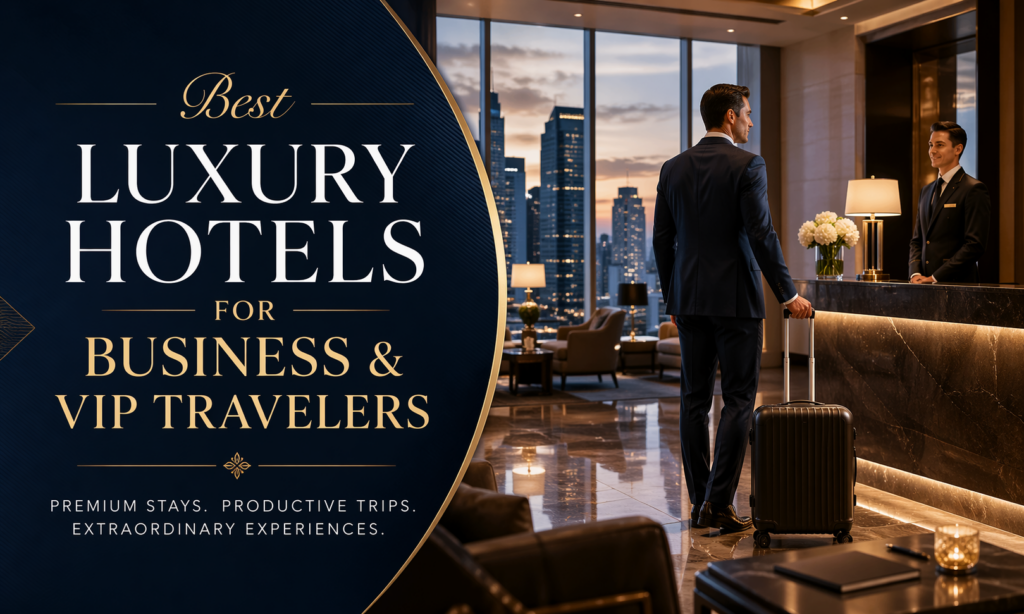
Why Luxury Hotels Matter for Business & VIP Travelers
(Best Luxury Hotels for) A luxury hotel is not just a prettier place to sleep when the trip itself carries weight. For business travelers, senior executives, diplomats, founders, investors, celebrity clients, and high-net-worth guests, the hotel often becomes a temporary office, a recovery zone, a meeting venue, and a reputation signal all at once. That matters more today because corporate travel is still a massive global engine. GBTA projected global business travel spending would reach $1.57 trillion in 2025, with 6.6% year-over-year growth, followed by an expected 8.1% rebound in 2026. That tells you something important: serious business travel did not disappear. It evolved, and premium stays now compete on productivity, privacy, and personalization rather than on marble floors alone.
That shift changes what “best luxury hotel” really means. The best property for a VIP traveler is rarely the one with the flashiest lobby. It is the one that removes friction before friction even appears. Think about the difference between a hotel that looks expensive and a hotel that quietly makes your arrival seamless, your meeting effortless, your sleep deeper, and your departure invisible. That is the real benchmark. A luxury hotel for elite travel should feel like a well-run control room in a beautifully designed shell. When every minute has a price tag, convenience becomes a form of wealth. That visibility creates risk, privacy becomes a form of comfort. When exhaustion can ruin tomorrow’s negotiation, rest becomes a business tool, not a leisure bonus..
Current Trends Shaping Luxury Business Stays
The modern luxury stay is being reshaped by a few strong currents, and they all point in the same direction: less generic glamour, more tailored utility. Skift’s luxury travel research says the market is moving away from pure material indulgence and toward meaning, privacy, space, personalization, authenticity, and wellness. That sounds abstract at first, but it becomes very concrete inside a hotel. It means travelers increasingly prefer properties that feel custom-fit to their routines and preferences rather than visibly expensive for the sake of appearance. In other words, exclusivity now feels more like intelligent curation than obvious excess.
The business side of travel is changing, too. Hilton’s 2026 trends reporting noted that premium club environments are being positioned as places for both relaxation and productivity, not just snacks and status. In the same report, Hilton cited that 29% of business travelers explored destinations with colleagues outside official activities, and Lyft data indicated business riders were twice as likely to go to a tourist destination as other riders. That means the line between work and leisure keeps getting blurrier. The hotel has to support both modes without making either one awkward. The best luxury hotels understand that a traveler might need a quiet breakfast before a board meeting, a polished lounge for an informal investor conversation, and a restorative wellness setup after a red-eye flight, all in the same 18-hour window.
What Defines the Best Luxury Hotel Today
Prime Location and Fast Access
Location still rules, but not in the old-fashioned sense of simply being “central.” For business and VIP travelers, the best location is the one that shrinks the day. A hotel should sit close to financial districts, embassies, convention hubs, government offices, or premium retail and dining corridors, depending on the purpose of the trip. Just as important, it should make airport transitions easy and reduce the number of unpredictable variables between landing and arriving. A 20-minute difference in transfer time may sound small on paper, but when a traveler lands late, has security concerns, or is jumping straight into meetings, that gap matters. This is where elite hotels quietly win or lose.
Current hotel positioning in major business cities shows exactly what matters. The St. Regis Jakarta highlights its place in the Golden Triangle and proximity to the city’s three main business districts, while also offering airport shuttle service and substantial meeting facilities. Le Méridien Jakarta emphasizes that it is steps from the MRT station and Jakarta’s CBD, while Park Hyatt Jakarta positions itself near the Presidential Palace, City Hall, and central corporate venues. These are not random marketing details. They are signals that the property understands executive movement patterns. In premium business travel, a hotel that cuts transport friction can be more valuable than a hotel with a more dramatic design story.
A great location also changes how the traveler feels. If the hotel is close enough to make your schedule breathable, the whole trip becomes calmer. You gain time to prepare, time to recover, and time to think. That is a serious advantage when the trip includes presentations, negotiations, investor meetings, media appearances, or high-level client hosting. The best luxury hotels do not just give you an address. They give you control over your day.
Suites, Workspaces, and Sleep Quality
The room is where the promise of a luxury hotel becomes real. A VIP business traveler does not need a large room just for visual impact. They need a space that supports several identities at once: guest, executive, host, and exhausted human being. The best luxury hotels solve this by offering real suite logic. That means separate living and sleeping areas, useful tables, thoughtful lighting, strong sound insulation, intuitive storage, reliable Wi-Fi, and enough floor space to meet someone privately without feeling like you are conducting business at the edge of a bed.
Hotel examples make this very clear. The Westin Jakarta promotes suites with separate living and dining areas and explicitly describes them as useful for private meetings with valued clients through its Club Lounge access and meeting-friendly environment. Le Méridien Jakarta sells its suites on space, panoramic views, and Executive Club access, while also stressing convenience for both business and leisure use. Park Hyatt Jakarta combines spacious rooms and suites with a 24-hour fitness environment and central access, which matters because comfort without functionality is only half a solution.
Personalized Service and Discretion
This is where true luxury separates itself from premium accommodation. Personalization is no longer a decorative extra. It is one of the core reasons elite travelers choose a top property in the first place. Skift’s luxury travel insights make this explicit by saying personalization and authenticity are redefining exclusivity. Forbes Travel Guide’s 2026 awards coverage also reinforces that luxury hospitality continues to evolve at the very top end of the market. The message is simple: the modern guest wants service that feels bespoke, intuitive, and calm rather than loud or performative.
You can see how that works in real hotels. The St. Regis Jakarta markets its signature 24-hour butler service, a classic marker of luxury that still matters because it compresses effort. The Paiza Collection at Marina Bay Sands notes that butlers are available 24 hours a day for in-suite tasks and broader coordination. Jumeirah Burj Al Arab highlights in-suite check-in and 24-hour private butler access, while Londoner Court Macau frames its experience around a world-class butler program and an “ultra-VIP” model. These are not just romantic old-world flourishes. For high-profile travelers, discreet service means fewer public touchpoints, fewer delays, fewer explanations, and less exposure.
Here is a useful way to think about it: personalized service is like a great stage manager. You barely notice it, but everything runs better because it is there. Flights change, guest preferences shift, dinner plans move, garments need pressing, transport needs confirming, meeting spaces need adapting, and privacy needs protecting. A strong luxury service team absorbs those moving parts without turning them into visible chaos. That is why experienced travelers often remember service more vividly than decor. Beautiful design gets attention. Precise service earns loyalty.
Amenities That Justify the Premium (Best Luxury Hotels for)
Executive Lounges and Private Meeting Spaces
Not every expensive amenity matters equally to a business traveler. Some features are nice for social media. Others genuinely improve the trip. Executive lounges, club floors, and private meeting environments belong in the second category. Hilton’s 2026 trends coverage described Club Signia as a place with chef-driven dining, personalized concierge service, and an atmosphere that supports both relaxation and productivity. That is exactly the sweet spot premium business hospitality is chasing. A strong lounge is not just a room with snacks. It is a buffer. It gives a traveler a place to reset, conduct informal meetings, work quietly, or entertain lightly without committing to a full restaurant reservation or public lobby setting.
Here is a quick framework for what actually matters most:
| Luxury Hotel Feature | Why It Matters for Business & VIP Travelers |
|---|---|
| Executive lounge access | Creates a quiet base for informal meetings, work blocks, and premium downtime |
| Private meeting spaces | Supports discreet conversations without leaving the property |
| Airport transfer support | Reduces friction, stress, and timing risk on arrival and departure |
| Suite with separate living area | Improves privacy, hosting ability, and work-life separation |
| Butler or dedicated concierge | Solves logistical problems quickly and discreetly |
| Strong wellness and sleep setup | Protects performance across meetings and time zones |
When a luxury hotel gets these basics right, the higher rate starts to make sense. It is no longer just a room charge. It becomes an efficiency package.
Wellness, Dining, and Recovery (Best Luxury Hotels for)
There was a time when wellness in hotels was treated like a leisure bonus. That era is over. In premium business travel, wellness is now part of performance management. If a traveler lands after a long-haul flight, has one evening to reset, and needs to be sharp the next morning, the quality of the hotel’s recovery ecosystem suddenly becomes incredibly practical. Skift’s research points to wellness becoming central to luxury, and that reflects a broader truth: elite travelers now care deeply about energy, clarity, sleep, nutrition, and pace.
Hotels are responding in visible ways. Park Hyatt Jakarta promotes its spa, city-view pool, and 24-hour fitness center. The St. Regis Jakarta includes a full spa and extensive wellness facilities. In Hilton’s 2026 trend coverage, quiet, restorative environments and personalized support are framed as part of the appeal, not separate from it. That shift matters because modern executives are not only buying prestige. They are buying the ability to show up well. A hotel that helps a guest recover from jet lag, eat properly, exercise on schedule, or sleep more deeply may indirectly improve the outcome of the entire trip.
Best Cities and Hotel Styles for Elite Business Travel (Best Luxury Hotels for)
The best luxury hotel is not the same in every city because the role of the trip changes with the destination. In some cities, the priority is speed and business-district access. In others, it is discretion, hosting power, or prestige. Singapore works exceptionally well for executives who want precision, safety, and strong infrastructure, and properties like The Paiza Collection at Marina Bay Sands show how dedicated butler support strengthens the ultra-premium end of that market. Jakarta makes sense for travelers who need proximity to corporate zones and government-facing movement, which is why properties such as The St. Regis Jakarta, Park Hyatt Jakarta, Le Méridien Jakarta, and The Westin Jakarta emphasize central access, suites, lounges, and meeting capability.
Dubai shines for travelers who want grand hospitality, strong international connectivity, and polished service theater. Forbes Travel Guide highlights examples like Jumeirah Burj Al Arab, where suite check-in and 24-hour butler access support the highest-end guest expectations, and business-oriented luxury addresses in DIFC-linked areas also remain compelling for finance and investor traffic. London excels when the traveler wants heritage, privacy, and concierge power. Hotels like The Connaught and Shangri-La The Shard, London are notable for butler-backed suite experiences and high-touch personalization. Macau now offers an especially interesting “hotel within a hotel” model through properties like Londoner Court, which packages a highly controlled ultra-VIP environment.
Booking Strategy, Security, and Value (Best Luxury Hotels for)
How to Judge ROI, Privacy, and Flexibility
Luxury hotels are expensive, but the smartest travelers and travel planners do not ask only, “What is the nightly rate?” They ask, “What problems does this stay solve?” That is the right lens. Amex GBT’s reporting on rising travel costs is a reminder that rate sensitivity still exists, even at the premium end. So the real evaluation should focus on total trip value: how much time the hotel saves, how much energy it preserves, how much discretion it provides, and how much friction it removes.
Start with privacy and security. High-profile travelers should look for controlled arrival processes, discreet check-in options, reliable transport coordination, floor privacy, and staff who understand confidentiality. Hotels with butler or concierge-led handling often outperform standard luxury properties here because they reduce public touchpoints. Then look at flexibility. Does the hotel allow early arrival support, late check-out options, rapid garment care, easy meeting-space booking, and room categories that support working and entertaining? These details often matter more than whether the bathroom has another marble finish or the minibar has an extra imported drink.
Then comes hard value. A suite with lounge access may cost more upfront, but it can replace outside breakfast meetings, reduce restaurant spend, provide a steady work environment, and lower the stress of finding quiet space during a packed itinerary. Airport transfer support can reduce timing risk. Strong in-house dining can save an evening. A wellness setup can help a traveler function better the next day. That is the real ROI picture.
Conclusion (Best Luxury Hotels for)
The best luxury hotels for business travelers and VIP travelers are no longer defined by glamour alone. They win by combining access, privacy, excellent suites, intuitive service, productive common spaces, and strong recovery amenities into one smooth experience. Current travel data supports that this segment remains powerful: global business travel is growing, traveler expectations are getting sharper, and luxury is being redefined around personalization, space, meaning, rest, and convenience rather than display alone.
That is why the smartest premium hotel choice is rarely the most famous one on social media. It is the one that best supports the purpose of the trip. For one traveler, that means a central business-district hotel with a strong lounge and fast airport access. For another, it means a butler-led property with high discretion and in-suite hosting power. That a third, it means a wellness-forward hotel that helps protect energy through time-zone shifts. The common thread is simple: the best luxury hotel makes high-stakes travel feel lighter. When a property can do that consistently, it stops being an indulgence and starts becoming a competitive advantage.