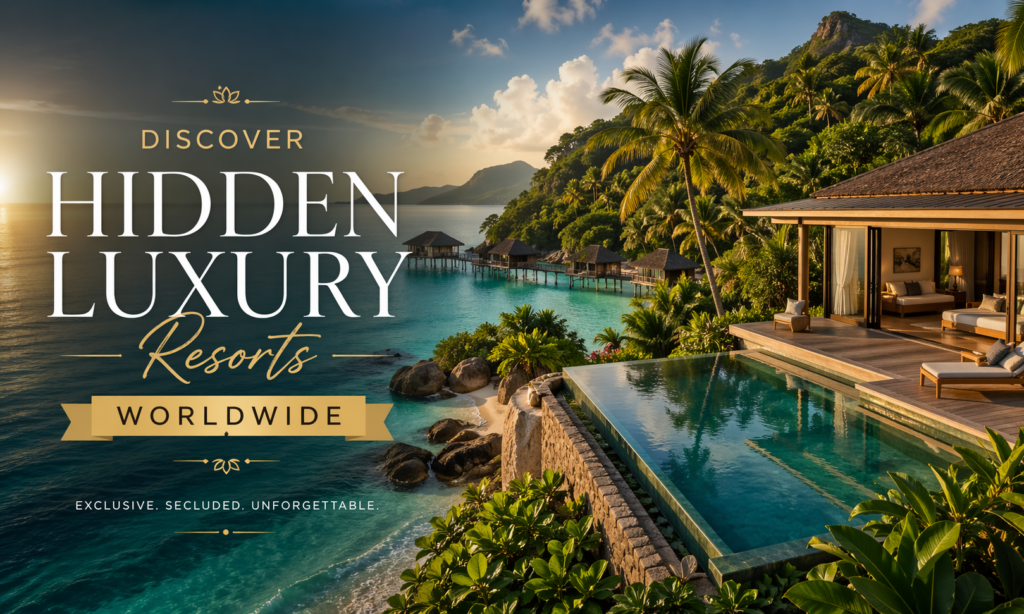
Why Hidden Luxury Resorts Are Rising
(Discover Hidden Luxury Resorts) The phrase hidden luxury resorts worldwide sounds glamorous, but it is also incredibly practical in 2026. Travelers with money to spend are not only searching for bigger suites or more polished marble lobbies. They are chasing calm, rarity, and places that still feel personal. That shift is not just a vibe; it lines up with current tourism behavior. UN Tourism reported strong global demand through 2025, while Virtuoso’s luxury-travel research showed travelers increasingly prioritizing personalized experiences, higher-value trips, and deeper emotional payoff from where they stay.
One of the clearest signals is behavioral: 78% of advisors said clients were opting for shoulder season or off-peak travel, and 76% said clients were favoring destinations with more moderate weather. In plain English, luxury travelers are trying to escape the crowd, the noise, and the obvious itinerary. A hidden resort is attractive because it promises something many famous hotels cannot: space to breathe, time to slow down, and the sense that the place still belongs to itself rather than to the algorithm.
There is also a psychological reason these luxury resort destinations are gaining traction. Public luxury used to mean being seen. Now it often means the opposite. The modern affluent traveler is less impressed by the fact that a property is famous and more interested in whether it feels rare, well-designed, and authentic to its location. Virtuoso described today’s demand as a “yearning for transformative experiences,” which is a useful way to frame this trend. The best hidden resorts do not just sell a room.
Travelers Want Experience, Not Just Status
A smart luxury travel SEO strategy has to reflect how buyers think. Travelers searching for best hidden luxury resorts, exclusive private island resorts, or boutique luxury retreats are usually not looking for generic opulence. They are hunting for texture. They want to imagine what mornings look like, how service feels, what the air smells like, and whether the destination offers a memorable identity beyond expensive bedding. That is why properties such as NIHI Sumba and Kisawa Sanctuary stand out. They are not hidden because they lack quality; they are hidden because their appeal comes from a specific ecosystem, culture, and rhythm of life. In the same way that a handwritten letter feels more intimate than a billboard, a hidden resort feels more meaningful than a famous mega-property. Travelers are paying for intimacy, not volume.
Off-Peak Travel and Climate-Aware Choices Are Reshaping Luxury
Another reason the best hidden resorts in the world are becoming more attractive is timing. Climate, crowds, and overexposure are now shaping booking decisions just as much as thread count or spa menus. When travelers choose shoulder season or places with more moderate weather, they naturally drift toward destinations that are less saturated. That opens the door for resorts in remote Indonesia, Mozambique, Panama, and French Polynesia to move from niche favorites to high-intent luxury choices. UN Tourism’s latest numbers show overall travel demand remains elevated, so the desire to avoid overtouristed hubs becomes even more important. The hidden resort becomes the luxury equivalent of finding a quiet cove while everyone else is squeezed onto the main beach. It is still premium, but it feels smarter, calmer, and more future-proof.
What Makes a Hidden Luxury Resort Truly Exceptional
Not every remote hotel deserves the label hidden luxury resort. Some are merely hard to reach. A true hidden luxury property combines privacy, service, place, and purpose in a way that feels seamless rather than forced. The location should be beautiful, but beauty alone is not enough. The best resorts have a strong internal point of view. They know whether they are about conservation, culture, adventure, romance, or wellness, and every detail supports that identity. You can feel it in the architecture, the excursions, the staff interactions, and even the silence. It is the difference between staying somewhere remote and staying somewhere unforgettable. Hidden luxury works when remoteness becomes a design feature, not an inconvenience.
A second marker is scale. Many top hidden resorts are intentionally small. Kisawa Sanctuary, for example, is built around just eight residences across a 300-hectare sanctuary on Benguerra Island. That changes everything. It affects how often you cross paths with other guests, how tailored the service feels, and how much of the landscape remains dominant over the built environment. Likewise, Islas Secas is not simply a hotel on an island. It is a resort across 14 remote islands, with a conservation-driven identity that turns geography into part of the guest experience. This is why the hidden-luxury category attracts travelers who are tired of places that feel efficient but emotionally flat. Small scale gives a property breathing room, and breathing room is a form of luxury in itself.
Privacy, Place, and Personalization
When people search for private luxury resorts worldwide, they are usually blending three needs into one query: privacy, strong sense of place, and high personalization. A great hidden resort delivers all three. Privacy means more than a gated villa. It means fewer distractions, less visual clutter, and the ability to feel temporarily removed from ordinary life. Sense of place means the resort is unmistakably rooted in its destination. NIHI Sumba draws heavily on Sumba’s equestrian culture and oceanfront wildness, while The Brando’s identity is inseparable from Tetiaroa’s reef-fringed private-island setting. Personalization is the glue that holds the experience together. At the best properties, service bends around the guest without becoming theatrical or intrusive. It feels easy, which is often the hardest thing to engineer well.
Access, Storytelling, and Local Identity
A hidden resort also needs narrative power. Travelers want a story they can feel before they can even explain it. That story might come from ecology, like The Brando’s deep commitment to stewardship, or from local craftsmanship and innovation, like Kisawa’s use of artisanal building methods alongside 3D-printing technology. It might come from wildlife and marine immersion, as at Islas Secas, or from adventure tied to local ritual, as with NIHI Sumba’s horse experiences on Nihiwatu Beach. The point is simple: luxury resort storytelling matters because it helps a property avoid becoming interchangeable. When the resort feels deeply connected to the land and community around it, guests stop feeling like consumers and start feeling like participants in a place.
How to Choose the Right Hidden Luxury Resort
Choosing the best hidden luxury resort worldwide is a little like choosing the perfect suit or the right watch. The expensive option is not automatically the right one. Fit matters more than flash. Some travelers want barefoot adventure, some want marine conservation, some want adults-only overwater romance, and others want all-inclusive ease on a private island. So the best way to choose is to begin with the kind of luxury you actually enjoy. Do you want to surf, snorkel, disappear, celebrate, detox, or reconnect? The answer matters because hidden resorts tend to be more distinctive than traditional luxury hotels. Their personalities are stronger, and that is a good thing. It means you are more likely to find a stay that genuinely matches your mood instead of forcing yourself into a polished but generic experience.
It also pays to think beyond the room. Transfers, weather, activity design, and service philosophy can change the trip completely. A remote resort that requires seaplanes, boat crossings, or multiple connections may feel thrilling to one traveler and exhausting to another. Sustainability claims should be specific, not vague. Dining should have enough depth to support a multi-night stay. Villa layout matters more in hidden resorts because you spend more time on property; a plunge pool, open deck, or private beachfront may shape your experience more than a grand lobby ever could. The right choice is the one where every moving part feels aligned, like a well-composed song rather than a playlist of random luxuries.
Location, Transfers, and Seasonal Timing (Discover Hidden Luxury Resorts)
Remote luxury sounds dreamy until you ignore logistics. One of the smartest ways to choose a secluded luxury resort is to balance remoteness with your tolerance for travel friction. A resort hidden in the best sense should feel emotionally distant from daily life, not punishingly difficult to reach. Seasonal timing matters too. Because many affluent travelers are now favoring shoulder seasons and moderate-weather destinations, you can often get a better experience by avoiding peak dates. That does not mean cheaper in every case, but it often means calmer. The sweet spot in hidden luxury is arriving when the weather still sings but the destination is not shouting.
Villa Design, Service Style, and Dining Depth
For a hidden luxury property, villa design is not a side detail. It is the main stage. Kisawa’s residences include private beaches, open-air decks, infinity pools, and outdoor day areas, which tells you immediately that the property is designed for immersion and space. Nayara Bocas del Toro leans into adults-only overwater villas with private plunge pools, making it especially appealing for romance-led travel. When accommodations are private and self-contained, the resort can feel less like a hotel and more like a temporary world built for your pace. Dining matters just as much because remote destinations keep you on-site. A hidden luxury resort should never leave you feeling trapped by its menu. Good luxury expands freedom; it does not narrow it.
Sustainability That Is Actually Visible
This is where many luxury brands talk big and say little. The best hidden resorts make sustainability tangible. Islas Secas says its eco-resort is primarily powered by renewable solar energy via 1,500 photovoltaic panels. The Brando’s Sea Water Air Conditioning system, in place since 2014, reduces energy consumption for cooling by up to 90% compared with traditional methods. Kisawa positions low-impact design as part of its core identity, while its surroundings connect directly to the marine biodiversity of the Bazaruto Archipelago. These are not decorative claims. They are operational decisions, and guests increasingly care about that. In a world where crowded tourism can erode the very places people come to admire, visible stewardship becomes part of the luxury proposition.
Best Hidden Luxury Resorts Worldwide (Discover Hidden Luxury Resorts)
Here is a snapshot of standout hidden luxury resorts worldwide that blend privacy, story, and memorable design.
| Resort | Region | What makes it special | Best for |
|---|---|---|---|
| NIHI Sumba | Indonesia | Award-winning wild-beach resort with Sumba horse culture and adventure-led barefoot luxury | Couples, surfers, design-minded escapists |
| Kisawa Sanctuary | Mozambique | 300-hectare sanctuary with only eight residences beside a protected marine ecosystem | Privacy seekers, conservation-minded luxury travelers |
| Islas Secas | Panama | 14 remote islands with a conservation-driven model and solar-powered operations | Families, marine explorers, private-island lovers |
| The Brando | French Polynesia | Iconic private-island eco-luxury with SWAC cooling and deep environmental stewardship | Honeymoons, milestone trips, ultra-private escapes |
| Nayara Bocas del Toro | Panama | Adults-only overwater villas with plunge pools and a romance-first atmosphere | Honeymoons, couples, unplugged romance |
Asia’s Wild Barefoot Escape (Discover Hidden Luxury Resorts)
Asia remains one of the most compelling regions for hidden luxury resort travel, especially for travelers who want a stronger balance between nature and service. While major Asian resort markets are full of polished luxury, the hidden standouts tend to feel wilder, more emotional, and more rooted in the surrounding culture. That is exactly why NIHI Sumba continues to command so much attention. It is not selling the standard tropical fantasy of infinity pools and umbrella drinks, even though it has the beauty to play that game. It sells something more magnetic: the feeling of escaping into a cinematic coastline where surfing, horses, local tradition, and open space shape the stay. In 2024 it was named Indonesia’s Best Hotel by Condé Nast Traveler, and in 2025 it landed on the Forbes Travel Guide Edge List, which underlines how strongly it resonates in the current travel market.
NIHI Sumba, Indonesia
NIHI Sumba is one of those rare luxury resort Indonesia properties that feels both elevated and elemental. The resort describes itself as a place where barefoot luxury meets wild adventure, and that is a sharp summary rather than a marketing cliché. Its signature horse experiences on the beach connect directly to Sumba’s living equestrian traditions, which gives the resort a cultural heartbeat that many high-end properties lack. This is the kind of place for travelers who do not want their luxury sealed off from the real world. They want ocean, wind, movement, and memory. If your idea of luxury is hearing almost nothing but waves, then stepping into deeply thoughtful service whenever you need it, NIHI Sumba belongs near the top of your shortlist.
Africa’s Conservation-Led Sanctuary (Discover Hidden Luxury Resorts)
Africa’s hidden luxury scene often delivers something especially powerful: the feeling that the landscape is still the main character. Kisawa Sanctuary on Benguerra Island captures that beautifully. The property sits within a 300-hectare sanctuary on the southern tip of the island, adjacent to one of the richest subtropical marine ecosystems in the Indian Ocean. It combines artisanal building practices with advanced technology, including 3D-printing methods, while keeping a low physical footprint where possible. That combination matters because it reflects a bigger shift in luxury travel. Guests are no longer satisfied with isolated indulgence. They want indulgence that coexists with ecological intelligence and cultural respect. Kisawa answers that demand with unusual clarity.
Kisawa Sanctuary, Mozambique
That feels designed for travelers who believe private luxury travel should be expansive rather than performative. With only eight residences, each framed by beach, forest, or dunes, the resort offers a kind of hush that is hard to manufacture. Every detail points away from crowd energy and toward personal space. Its adventure program also leans into the Bazaruto Archipelago rather than distracting from it, which is exactly what you want from a destination-led resort. Kisawa is not trying to be everything to everyone. It is building a sanctuary in the literal sense, and that focus makes it more seductive. For travelers tired of luxury that feels copied and pasted, Kisawa offers something fresher: privacy with meaning.
The Americas’ Private-Island Secret (Discover Hidden Luxury Resorts)
In the Americas, many luxury travelers automatically think of famous Caribbean names or highly photographed Central American resorts. Yet one of the most compelling hidden private island resorts is Islas Secas in Panama. Its appeal starts with geography: 14 remote islands surrounded by marine life and shaped by a conservation-first philosophy. But geography alone is not enough. What makes Islas Secas feel special is that its environmental story is built into operations, not simply layered on top of them. The resort says it is primarily powered by renewable solar energy from 1,500 photovoltaic panels, and its stewardship program is tied to preserving the archipelago under Panamanian law. That combination of adventure, exclusivity, and visible environmental care is exactly the kind of premium mix modern luxury travelers respond to.
Islas Secas, Panama
Islas Secas is a strong pick for travelers who want their luxury island resort to feel active rather than sleepy. You get privacy, yes, but you also get the energy of exploration. Snorkeling, boating, wildlife encounters, and marine-focused adventure give the property a pulse that makes longer stays rewarding. This is not a resort that asks you to admire nature from behind glass. It invites you into it while still protecting comfort. If hidden luxury were a recipe, Islas Secas would be the version that swaps pure stillness for elegant motion. That is exactly why it feels current. It speaks to travelers who want their escape to be beautiful and alive at the same time.
The South Pacific’s Eco-Luxury Icon (Discover Hidden Luxury Resorts)
The South Pacific has always owned a strong share of the luxury imagination, but The Brando stands apart even in that rarefied field. Set on Tetiaroa in French Polynesia, it blends the fantasy of a private island with environmental systems that are unusually concrete. Its Sea Water Air Conditioning system uses deep ocean water to cool the resort and can cut energy consumption for air conditioning by up to 90%. That is the kind of technical detail that gives substance to a luxury narrative. It is not just paradise with clever branding. It is paradise supported by infrastructure designed to reduce impact. For travelers planning once-in-a-lifetime honeymoons or milestone escapes, that mix of beauty, privacy, and stewardship is hard to beat.
The Brando, French Polynesia
The Brando is what happens when exclusive luxury resort travel stops choosing between glamour and conscience. The villas are private, the setting is dreamlike, and the emotional pull of the destination is obvious from the start. Yet what gives the resort extra staying power in the luxury conversation is its seriousness about preserving the place that makes it desirable. That matters for SEO and for travelers, because the phrase best hidden luxury resorts worldwide increasingly implies more than privacy. It implies responsibility, originality, and a sense that the destination is being protected rather than consumed. The Brando fits that definition beautifully. It is aspirational, but it is not empty aspiration. It has a backbone.
Conclusion (Discover Hidden Luxury Resorts)
The best hidden luxury resorts worldwide are not simply expensive places in remote settings. They are rare environments where privacy, design, service, and local identity lock together so tightly that the trip feels impossible to replicate anywhere else. Right now, that matters more than ever. Global travel demand remains strong, but luxury travelers are becoming more selective, more climate-aware, and more interested in meaningful experiences over predictable prestige. That is why hidden resorts are winning attention. They promise not just comfort, but contrast. They let travelers step out of the crowded script and into something quieter, more personal, and far more memorable. If you are planning a high-end escape in 2026, the smartest luxury move may not be booking the most famous resort. It may be finding the one that still feels like a secret.