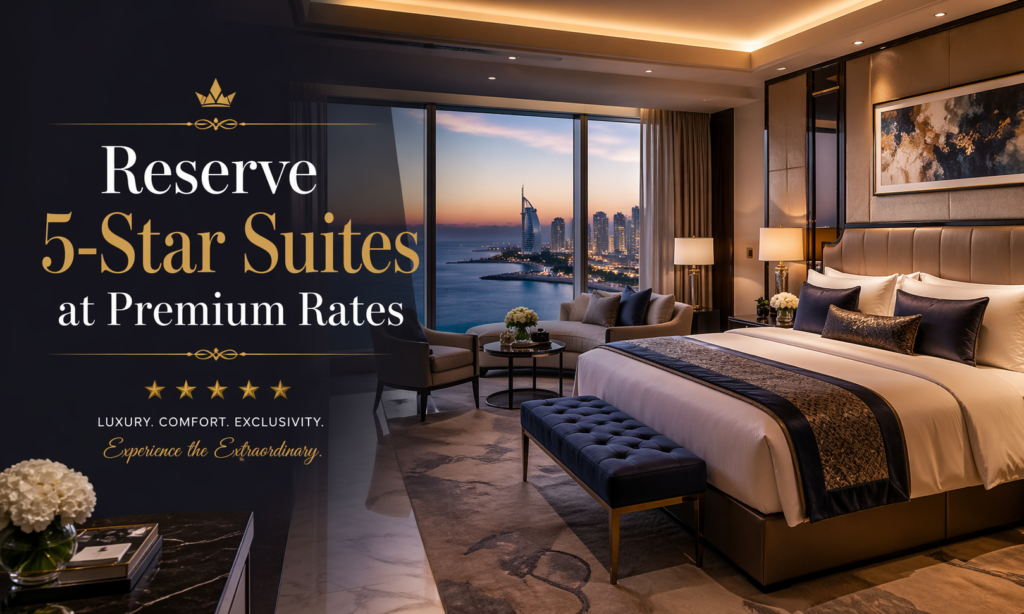
Reserve 5-Star Suites at Premium Rates
(Reserve 5-Star Suites) Booking a 5-star suite is not the same as booking a regular hotel room with nicer curtains and a better view. When travelers search for premium suites, they are usually paying for space, privacy, service, location, exclusivity, and the kind of experience that feels curated rather than standardized. That demand has stayed strong even while many travelers compare prices more aggressively online.
McKinsey noted that the luxury hotel segment was projected to grow faster than any other chain-scale hotel class, at about 6% annually through 2025, which helps explain why premium suite pricing has remained resilient rather than collapsing under competition. At the same time, Hilton’s 2025 travel trends research signals that many travelers want to get more out of the hotel itself, not just use it as a place to sleep, and more than half in one Hilton trend snapshot said they would gladly spend an entire vacation without leaving the hotel. That kind of behavior makes suites more valuable, because the room becomes part of the destination, not just a place to recover after sightseeing.
Understanding What Premium Suite Pricing Really Means
What separates a true 5-star suite from a standard luxury room
A genuine 5-star suite earns its premium by combining scale and service in a way that a standard room rarely can. You are not just paying for extra square footage. You are paying for a separate living area, elevated privacy, stronger views, better bathroom design, upgraded bedding, more attentive housekeeping, faster response times, priority access, and sometimes butler or concierge support that removes friction from the trip. In the luxury segment, the emotional promise matters as much as the physical product.
McKinsey’s work on luxury travel emphasizes that affluent travelers increasingly define luxury less by pure price and more by personalization, relevance, and memorable service. That shift matters because it tells hotels they can defend premium suite rates when they offer experiences that feel rare, smooth, and highly tailored. A suite is expensive because it is meant to feel like your own private domain inside a hospitality machine that is working quietly in the background. When the experience is done right, the rate is not only buying comfort. It is buying calm, convenience, and status without shouting about any of it.
Why premium rates stay high even when travelers compare dozens of options
At first glance, it seems like online comparison tools should push luxury suite prices down. In reality, the opposite often happens at the top end of the market. Price transparency teaches travelers how wide the gap is between an attractive room and a truly exceptional one. When a property has limited suites, prime location, strong brand reputation, and excellent service scores, it does not need to win on being cheap. It needs to win on being worth it. Hilton’s 2025 trend framing described travelers as wanting to “maximize every moment,” which is a useful way to understand current buying psychology. Many high-spending guests are not searching for the lowest rate.
They are searching for the least disappointing option. That changes everything. The traveler who fears wasting a honeymoon, milestone birthday, executive trip, or multigenerational family escape is often willing to pay more for certainty. Meanwhile, CBRE’s 2025 hotel outlook showed that even where broader hotel growth was modest, average daily rates remained supported by demand patterns and market discipline rather than collapsing into discounting. Premium suites sit at the sharpest end of that logic because supply is naturally scarce.
Why Demand for 5-Star Suites Keeps Rising
How luxury travel demand continues to support top-tier hotel pricing
The strongest reason 5-star suites continue to command premium prices is simple: people are still willing to pay for them. McKinsey’s hospitality analysis said the luxury segment was outpacing other hotel classes, while its broader travel research showed travelers are making more nuanced choices about where to spend and where to splurge. That pattern creates an interesting market dynamic. Someone may cut back on small indulgences during the year, then deliberately overspend on the hotel that anchors a special trip.
Booking.com’s 2025 research also points to travelers chasing more intentional and meaningful experiences, while Mastercard’s 2025 travel reporting highlighted the continued strength of Asia-Pacific destinations and the role of passions and purpose in shaping travel decisions. When demand is emotionally motivated rather than purely transactional, premium hotel rates become more durable. A suite is no longer just an accommodation product. It is part celebration venue, part private retreat, part social signal, and part productivity base for people blending leisure and work. That broader role helps explain why top-tier suites often remain expensive even when the wider market feels price-sensitive.
Why modern travelers are paying more for privacy, personalization, and in-hotel experiences (Reserve 5-Star Suites)
Here is the real shift: today’s luxury traveler often wants the hotel to do more than impress. They want it to reduce decision fatigue. That means fewer transfers, better wellness access, stronger dining, more flexible check-in, discreet service, quieter spaces, and the feeling that every detail has already been handled. Hilton’s luxury traveler research for 2025 highlights how influential luxury guests remain in shaping travel behavior, and one of the most revealing findings in its wider trends materials is that many people are happy to spend a major part of the trip inside the property itself.
That tells you why suites outperform standard rooms in many aspirational bookings. If the room becomes a sanctuary, then bigger living spaces, premium views, club privileges, private terraces, soaking tubs, and family-ready layouts suddenly feel practical rather than indulgent. Booking.com’s 2025 sustainability research also found that 69% of travelers want to leave places better than they found them, showing that values-based travel is becoming more mainstream. Luxury hotels that combine service with wellness, local sensitivity, and thoughtful design can charge higher rates because they are selling reassurance along with beauty.
The Best Time to Reserve 5-Star Suites at Premium Rates
How booking windows affect suite availability and pricing
Timing matters more with suites than with standard rooms because premium inventory is tiny. A hotel might have hundreds of standard rooms but only a handful of top suites that serious travelers actually want. That scarcity means the best suite options can disappear long before the destination looks sold out on travel sites. Early booking often works best for peak seasons, major holidays, destination weddings, big conventions, and headline events.
Last-minute strategies can still work in shoulder periods, but they are riskier if you care about a specific suite category, a particular floor, a connecting layout, or certain inclusions. This is where many travelers get trapped by the idea that luxury booking always rewards patience. Sometimes it does. Sometimes waiting is like showing up at an auction after the painting has already been sold. CBRE’s 2025 outlook and Amex GBT’s hotel monitoring both suggest that hotel rates remain shaped by market-level demand, inflation, and supply conditions, which means pricing is not random. If citywide demand, business travel, or event traffic is rising, the nicest suite inventory becomes one of the first products to harden in price.
Why seasonality, events, and destination popularity can change rates fast (Reserve 5-Star Suites)
Luxury suite pricing behaves a bit like airline pricing with a velvet rope. It reacts fast to signals that premium guests care about: school holidays, fashion weeks, film festivals, sports events, resort weather, cruise schedules, and long weekends in feeder markets. Mastercard’s 2025 travel data showed Asia-Pacific’s continued strength among trending destinations, which is a reminder that even regional demand surges can reshape pricing far beyond one city.
A destination that feels “normal” one month can turn into a high-yield market the next because of events, currency shifts, or sudden travel interest. Booking.com’s 2025 destination and prediction materials also reinforce that traveler behavior is increasingly driven by experience-led choices rather than routine patterns. So when demand clusters around moments that feel special, suite prices often jump first and soften last. If you are reserving a premium 5-star suite, the smartest move is to monitor not only the hotel calendar but the destination calendar. The room rate is never just about the room. It is about the total pressure on the place around it.
How to Get More Value Without Chasing Cheap Rates (Reserve 5-Star Suites)
Why booking direct can unlock stronger value than third-party platforms
Travelers love comparison sites because they feel efficient. Luxury hotels love direct booking because it protects margin, brand control, and guest data. That tension creates opportunity for the guest who understands the game. Direct booking often wins not because the base rate always looks lower at first glance, but because the total value is stronger once you factor in perks. Marriott publicly states that Bonvoy members get exclusive discounted rates and complimentary in-room Wi-Fi, while Hilton offers a Price Match Guarantee that says it will match a qualifying lower rate and give an additional 25% off in approved cases. Those are not tiny details.
They can turn a premium suite booking from “painfully expensive” into “expensive, but better justified.” Direct channels are also more likely to help with room preferences, special requests, elite recognition, flexible modifications, and cleaner communication if something goes wrong. In the luxury segment, service recovery matters almost as much as service delivery. When you are paying premium rates, the question is not just who had the cheapest visible number. The better question is who gives you the best outcome when the trip meets real life.
Loyalty benefits that quietly improve a luxury hotel stay
Loyalty programs are often treated like point-collecting games, but at the suite level they can function more like invisible comfort systems. Marriott Bonvoy and Hilton Honors both emphasize member rates and basic stay benefits, and those small advantages stack up faster in premium properties than many travelers realize. Free Wi-Fi sounds ordinary until you are working from a suite for three nights and avoiding premium internet surcharges.
Mobile check-in sounds minor until you arrive late and bypass a crowded front desk. Member recognition can lead to better room placement, smoother request handling, and a more flexible tone from the property. This is why loyalty at the luxury end feels less like coupon hunting and more like friction removal. You still pay a premium. You just get fewer annoyances for your money. That is a very different kind of value, and it matters because premium travel is often bought by people with one thing they do not want to waste: time.
Member rates, best-rate guarantees, and price-match opportunities
Let’s make this practical. If two suite rates look similar across channels, the better move is usually to check the hotel’s own site, log in to the loyalty program, and compare the total package rather than the headline number. Marriott says its members receive a preferred member rate through direct channels, and Hilton’s published guarantee creates an extra layer of protection if an eligible lower public rate appears elsewhere. That means the traveler who checks official channels first is not being naive. They are often playing smarter. Here is a simple comparison of how value can show up when reserving a 5-star suite:
| Booking path | Visible rate advantage | Typical value add | Best for |
|---|---|---|---|
| Third-party OTA | Fast comparison | Convenience, bundled search | Broad research stage |
| Hotel direct public rate | Brand-controlled pricing | Better support, clearer policies | Travelers wanting reliability |
| Hotel member rate | Preferred pricing | Wi-Fi, points, app tools, recognition | Repeat and premium travelers |
| Direct + price match route | Possible matched lower rate | Extra savings if claim qualifies | Careful shoppers with time to verify |
The cheapest-looking option is not always the best value option. In luxury travel, hidden value often lives behind the sign-in button.
When travel advisors and concierge-style booking support make sense (Reserve 5-Star Suites)
There is a point where self-booking becomes false economy. If the trip includes multiple suites, a celebration, airport transfers, custom dining requests, privacy concerns, or special amenities, a strong travel advisor can save more than they cost. McKinsey’s luxury travel discussion highlighted the evolving role of travel advisors, especially as affluent travel becomes more personalized and less standardized.
A good advisor is not just a salesperson. They are a negotiator, interpreter, and damage-control expert. They may secure breakfast, credits, upgrades, or preferred treatment that is hard to replicate through a casual online booking path. This matters most when the booking is emotionally important. A honeymoon suite, anniversary stay, executive retreat, or family villa-style suite is not the moment to save twenty dollars and lose control of the details. Think of an advisor as the backstage crew in a theater production. You may not see them once the curtain rises, but the performance can go very wrong without them.
What to Check Before Paying for a Premium Suite (Reserve 5-Star Suites)
Rate rules, cancellation policies, and prepaid booking traps
Luxury travelers sometimes overfocus on the room and underread the rate rules. That is how expensive mistakes happen. Hilton’s published discount information makes clear that some rates are Best Available Rate or flexible, while others are Non-Refundable and require full prepayment. That difference can matter far more than a small price gap, especially for premium suites where the nightly rate is already high. A prepaid suite might look like a smart move until a flight change, illness, meeting cancellation, or family issue blows up the itinerary.
Suddenly, what looked like a discount turns into a penalty. The wiser strategy is to match the rate type to the certainty of your trip. If dates are locked, a prepaid premium may be fine. If the journey has any moving parts, flexibility is often worth the extra spend. Luxury booking should feel confident, not brittle. Saving money on paper only to lose freedom in practice is one of the easiest ways to make a premium suite feel like a bad deal.
Hidden suite costs, resort fees, transfers, and service extras (Reserve 5-Star Suites)
The nightly rate is only the front door of the bill. What matters is the total stay cost once taxes, resort fees, dining, airport transfers, club access, parking, gratuities, spa add-ons, and family extras enter the picture. Premium suites can also trigger a kind of vacation amnesia where travelers stop calculating because the base rate already feels huge. That is dangerous. It is far better to stay intentional.
Ask whether breakfast is included, whether the transfer is complimentary, whether the lounge is worth paying for, whether the suite category includes occupancy limits, and whether late checkout is available. In some properties, the best-value suite is not the most glamorous one. It is the one that bundles enough practical benefits to reduce on-property spend. Amex GBT’s recent business travel pricing commentary also noted continued cost pressure at the higher end of travel, reinforcing the idea that premium hospitality costs can stay elevated even when travelers hope for relief. A smart luxury traveler does not just reserve a suite. They audit the full experience before committing.
Conclusion (Reserve 5-Star Suites)
Reserving 5-star suites at premium rates makes sense when you understand what the price is really buying. You are not only paying for a larger room. You are paying for certainty, privacy, comfort, service, and a smoother version of travel where the hotel itself carries more of the experience. Current hospitality and travel data show that luxury demand remains resilient, travelers are placing more emotional value on premium stays, and hotels continue to defend top-tier pricing through scarcity, service quality, and direct-booking ecosystems.
That means the smartest strategy is not chasing the lowest number on the screen. It is choosing the booking path that delivers the strongest total value, the right level of flexibility, and the fewest points of friction. When a suite is booked with good timing, direct-rate awareness, and a clear understanding of the full stay cost, the premium rate starts to feel less like a splurge and more like a deliberate investment in the quality of the trip.